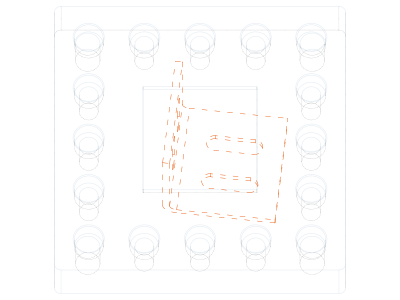
Aluminum fixture plates with conforming nest pockets, generated from your STEP geometry.
| Material | Aluminum 6061-T6 |
| Plate thickness | 25.0 mm |
| Nest pocket depth | 3.0 mm |
| Part clearance | 0.2 mm per side |
| Plate margin | 40.0 mm per side |
| Grid pitch | 25.0 mm |
| Grid holes | M8 clearance — 8.5 mm bore, 13.0 mm CB |
| Grid counterbore depth | 8.0 mm |
| Corner holes | M10 clearance — 11.0 mm, 15.0 mm inset |
| Tool radius | 3.175 mm (1/4″ endmill) |
| Corner fillet | 3.0 mm |
| Surface finish | as-machined |
Fixture plates are for parts that need a dedicated setup but don't justify a custom tombstone. The part must have at least one flat face for seating — the generator orients it face-down and projects a conforming pocket from the bottom profile. Grid holes on a 25.0 mm pitch accept standard modular clamps. Four corner holes mount the plate to the machine table.
If the part fits in a 6″ vise, soft jaws are faster to machine and easier to store. If you need quick-change capability across multiple parts, zero-point plates add pull-stud registration. Fixture plates fill the gap: irregular geometry, second-op work, or parts too large for jaw stock.
Generated from real STEP files in the stress test suite. Plate dimensions, pocket method, and grid hole count vary with part geometry.
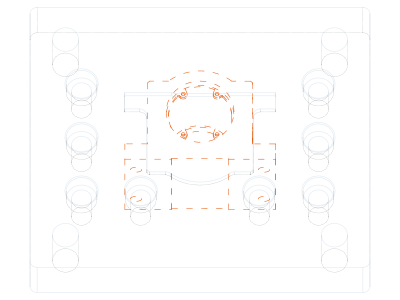
| Plate | 143.5 × 121.3 × 25.0 mm |
| silhouette | |
| Grid holes | 8 |
| Plate | 130.8 × 130.8 × 25.0 mm |
| silhouette | |
| Grid holes | 16 |
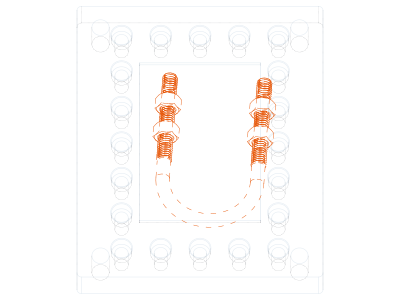
| Plate | 156.8 × 190.7 × 25.0 mm |
| bbox fallback | |
| Grid holes | 20 |
No Z-aligned flat face for fixture seating. Parts without a planar bottom cannot use fixture plates. See Soft Jaws for alternative workholding.