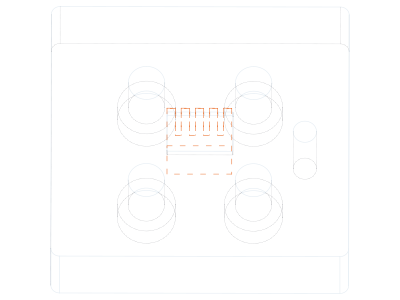
Upload a STEP file. Get a zero-point clamping plate — conforming nest pocket on top, 52 mm pull stud interface on bottom — as a verified STEP solid.
| Material | Aluminum 6061-T6 |
| Plate thickness | 30.0 mm |
| Nest pocket depth | 3.0 mm |
| Part clearance | 0.2 mm per side |
| Plate margin | 40.0 mm per side |
| Tool radius | 3.175 mm (1/4″ endmill) |
| Corner fillet | 3.0 mm |
| Max plate size | 350 × 350 mm |
| Surface finish | as-machined |
| Bolt circle | 52.0 mm |
| Pull studs | 4 at 90° spacing (45° start) |
| Through-bore | 12.5 mm |
| Counterbore | 20.0 mm dia × 10.0 mm deep |
| Locating pin | 8.0 mm dia at 36.0 mm offset |
OPJAW generates the hole geometry. You supply the pull studs — centering, compensating, and clamping — to match your receiver. The 96 mm bolt circle is not currently supported.
Zero-point plates lock onto spring-loaded receivers via pull studs. Pallet swap takes seconds — you build the next setup offline while the spindle cuts the current job. The tradeoff is 30 mm of Z-height and a mechanical joint between your part and the table.
If you change setups more than twice a shift, the time wins. If you run one part number for a week, a fixture plate bolted directly to the table wins on rigidity.
The other advantage is datum continuity. The same plate with the same studs locks into receivers on the mill, the CMM, the EDM, and the grinder. The part datum does not move between machines because the receiver defines it. Fixture plates do not transfer — they bolt to one table.
The 52 mm bolt circle limits part footprint. If the conforming pocket extends far enough to intersect the pull stud holes, the system rejects the part for zero-point and scores fixture plates instead. Of the 20 parts in the stress test suite, 6 fit the 52 mm interface.
| Zero-Point Plate | Fixture Plate | 6″ Vise Jaws | |
|---|---|---|---|
| Plate thickness | 30.0 mm | 25.0 mm | 50.8 mm (jaw height) |
| Clearance | 0.2 mm / side | 0.2 mm / side | 0.15 mm / side |
| Nest / pocket depth | 3.0 mm | 3.0 mm | 12.7 mm |
| Clamping method | Pull studs (52 mm BC) | Bolted to table | Vise jaw grip |
| Setup time | seconds (pallet swap) | 15–45 min | 5–15 min |
| Requires flat bottom | yes | yes | no |
| Max part envelope | ~120 mm footprint | ~270 mm footprint | 152.4 mm jaw width |
| Best for | high-mix, multi-machine | large parts, long runs | compact parts |
Generated from STEP files in the stress test suite. Plate dimensions scale to the part footprint. Tool radius compensation rounds internal pocket corners to the cutter diameter.
| Plate | 102.3 × 94.5 × 30.0 mm |
| silhouette |
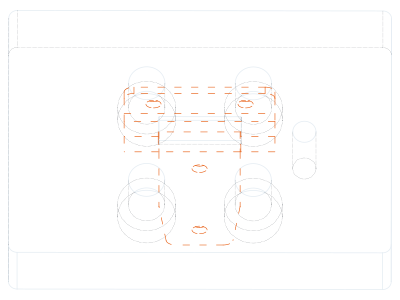
| Plate | 132.0 × 92.0 × 30.0 mm |
| silhouette |
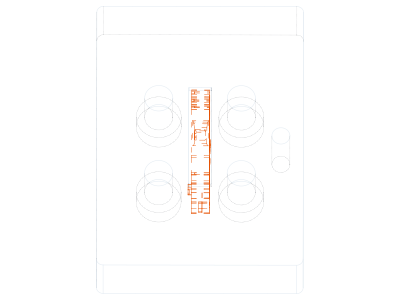
| Plate | 92.0 × 127.0 × 30.0 mm |
| bbox fallback |
Pull stud #1 at (18.4, 18.4) intersects nest pocket. Part footprint exceeds the 52 mm bolt circle clearance. Use a fixture plate instead — same nest pocket, no bolt circle constraint.
No Z-aligned flat face for seating. Parts without a planar bottom cannot use zero-point plates or fixture plates. See how fixture generation works for how seating faces are selected.
14 of 20 test parts are rejected for zero-point — most because their footprint intersects the pull stud holes. The auto-selector scores all four strategies and recommends the best fit.
Every output is measured by the geometric oracle before download. Bounding box, volume, and plate thickness are checked against declared ranges. If a plate measures outside 30.0 ± 0.1 mm in Z, you get an error, not a file.