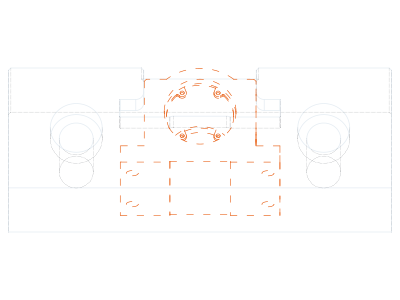
Matched left/right jaw pair for Kurt-style 6″ vise. Part-conforming pockets from STEP geometry.
Soft jaws are machinable aluminum blanks that bolt to a vise. You cut a pocket into each jaw face that matches your part profile. The pocket grips the part during secondary operations — finishing cuts, drilling, tapping — without marring machined surfaces or deforming thin walls. Hard jaws grip raw stock with serrations. Soft jaws grip finished geometry with a conforming cavity.
OPJAW generates the pocket automatically. Upload a STEP file, and the system extracts a 2D grip profile from the part geometry, applies tool radius compensation, and outputs a matched jaw pair as downloadable STEP solids. Every output is measured by the geometric oracle before you see it.
| Jaw blank | 152.4 × 50.8 × 50.8 mm |
| Grip depth | 12.7 mm |
| Clearance | 0.15 mm per side |
| Tool radius | 3.175 mm (1/4″ endmill) |
| Min wall thickness | 3.0 mm |
| Bolt pattern | 2 × 2 grid, 98.425 mm c-c |
| Bolt holes | 1/2″-13 UNC, 13.494 mm clearance |
| Counterbore | 20.638 mm dia × 12.7 mm deep |
| Material | Aluminum 6061-T6 |
| Surface finish | Ra 1.6 µm |
| Workholding force | 6000 PSI hydraulic |
| Oracle tolerance | bbox ±0.1 mm |
Clearance, tool radius, shrinkage factor, and minimum wall thickness are overridable at generation time.
The pocket profile is extracted from the part geometry in the grip zone — the bottom 12.7 mm of the part as positioned in the jaw. Four extraction methods run in a tier cascade. If one times out or fails quality checks, the next takes over. Each tier runs in an isolated subprocess with a hard timeout.
| Tier | Method | Timeout | Approach |
|---|---|---|---|
| 0 | Z-bounded slice | 30 s | Clip part to grip zone, section at multiple Z heights, union into 2D profile |
| 0.25 | Multi-Z slice | 45 s | Lower area threshold — tolerates complex internal geometry |
| 0.35 | Cross-section | 30 s | Single section at grip zone midpoint — preserves concave features |
| 0.5 | 3D conformal | 45–120 s | Subtract part from envelope, remove undercuts with Z-prism extrusions |
After profile extraction, the pocket is expanded by clearance + tool radius, then contracted by tool radius. This double-offset technique rounds internal corners to the cutter diameter while maintaining exact clearance on straight walls. The full pipeline is described in How Automated Fixture Generation Works.
Generated from real STEP files in the stress test suite. Each jaw pair is a distinct geometry — pocket profile, bolt clearance, and chamfer placement vary with the part.
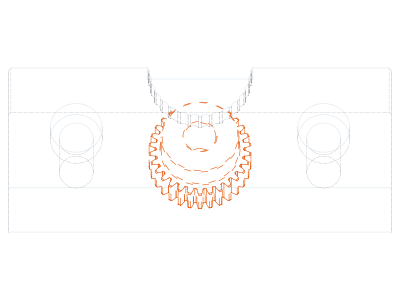
Every tooth contour captured in the grip profile. Z-bounded slice at tier 0.
| Part bbox | 40.5 × 40.6 × 23.9 mm |
| z_bounded_slice | |
| Status | PASS |
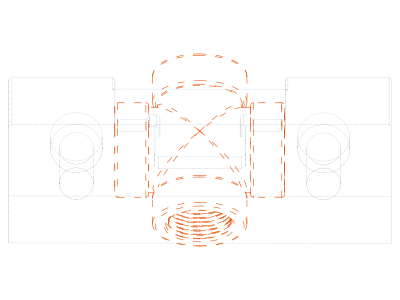
No flat faces, hollow interior. Multi-Z slice handled the complex internal geometry.
| Part bbox | 67.6 × 67.6 × 37.6 mm |
| multi_z_slice | |
| Status | PASS |
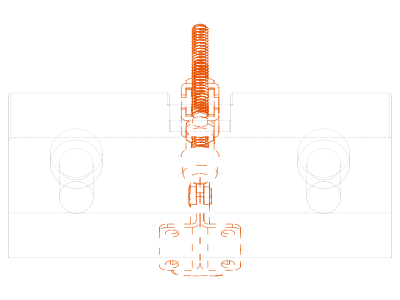
Part Z = 155.4 mm, jaw height = 50.8 mm. Pocket is valid but the part protrudes 104.6 mm above the jaw face.
| Part bbox | 32.1 × 53.4 × 155.4 mm |
| z_bounded_slice | |
| Status | WARN |
If the part has a dominant flat face and needs modular clamping, a fixture plate gives you an M8 grid for standard clamps. If you need quick-change capability with pull-stud registration, zero-point plates add locating precision. If the part requires machining from both sides, the multi-op vise strategy generates two sets of jaws — Op1 in the original orientation, Op2 flipped 180°. See Fixture Selection for Irregular Parts for how the system scores each strategy.